

Lassie
A special exhibition from the Minds Eye centre
6.05.26
Grand Old house Cayman Islands
6pm - 10pm
Curators Statement
As an intuitive artists, Miss Lassie creates from a deep wellspring of spiritual understanding. Her visions compelled her to create as praise - a visual language that celebrates the possibility of art as a divine language.
The works brought together in the exhibition reflect two interwoven currents within her practice. Biblical scenes articulates her spirituality, rendered with depth and conviction - while narrative landscapes explore the history of the Cayman Islands.
Together, these elements showcase the most pervading elements of her works; highlighting her consistent style and commitment to her visions.
In Miss Lassies work, painting becomes her testimony, and her record for posterity. Her markings invite viewers into the heart of what art can be considered to be in its purest form. there is no effort to conform to technique and no pandering to social viewpoints. it is clear that within this work the artists communicate her one truth; that she must paint to the visions given to her.

A Sight in the Sky
In this arresting work, Miss Lassie captures a vision of Jesus appearing in the sky over Grand Cayman. For her, this was not metaphor or dream, but revelation. It was a real, remembered experience. With bold strokes and radiant color, she shares that vision, collapsing the boundary between sacred time and contemporary life. The result is a powerful, visionary landscape.By placing the divine directly in Caymanian skies, Miss Lassie asserts that revelation is ongoing, and that ancestry includes not only those who lived long ago, but those gifted with spiritual insight. God’s presence, for her, is not confined to scripture. The golden figure becomes a heavenly messenger, appearing, witnessing, experiencing and guiding, just as her ancestors once did. The painting becomes a canvas of memory and faith, as well as cultural and national identity.
Jacobs Dream

In this compelling and symbolic work, Miss Lassie brings to life Jacob’s dream of a ladder reaching from earth to heaven. It is a radiant vision that bridges the human and the divine. The ladder becomes more than a physical structure; it is a conduit for revelation, a link across realms and generations. As it ascends, it connects not only heaven and earth, but memory and prophecy, the personal and the collective, the past and what’s to come. This piece speaks to the movement across generations, where dreams become vessels for memory, faith, inheritance and connectedness. Through it, Miss Lassie suggests that divine encounters are not isolated moments, but ripples through time – carried forward in visions.

Tongues of Fire
In Tongues of Fire, Miss Lassie transforms the Biblical moment of Pentecost, lining the disciples in a solemn row as delicate gold flames dance on their heads, recreating the sign of the Holy Spirit’s descent. The composition echoes the intimacy of the Last Supper, with a long table stretched before them, architectural features to each side and a checked tablecloth hanging over the scene. The X shaped table legs become part of the corresponding narrative, again echoing the familiar painting and subtly evoking the cross. Through these layered symbols, Miss Lassie’s vision explores the connectedness of Biblical storytelling across time and space, revealing how artists share visual language to .
Simeon and Jesus in the Synagogue
Simeon and Jesus in the Synagogue is perhaps recognized as Miss Lassie's most "painterly work" in that it displays more classic technique than her traditional style. This work channels the deep conviction and faith that shaped Miss. Lassie's life and her commitment to her visions. Simeon, recognizing the infant Jesus as the fulfillment of divine promise, resonates with her own experience of sudden, overwhelming spiritual revelation. Painted with her signature intuitive approach, the work reflects her belief that sacred truth is made visible through inspiration rather than formal technique. Like much of her art, this piece transforms a familiar passage of scripture into a vivid, personal encounter. Rendered through bold colors and flattened space, the viewer is immediately presented with the child, as Simeon was, and is held in the moment, compelled to recognize its holiness.

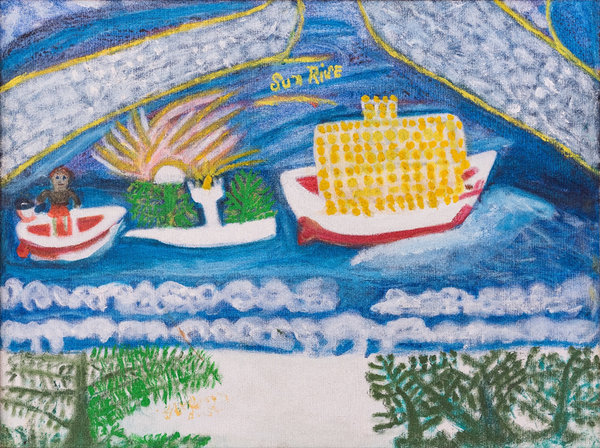
Sunrise after the Flood
In this revelatory painting, Miss Lassie presents a striking metaphor for survival, transformation, and the eternal return of hope. While the imagery evokes the biblical flood from Genesis, it also resonates with the 1932 hurricane in the Cayman Islands which was locally remembered as a “tidal wave” or “great flood.” It was a defining event in Cayman’s collective memory. Nature, here, becomes both destroyer and healer. The rising sun over receding floodwaters marks more than a new day. It signals renewal: of faith, of community, of life itself. The flood is both literal and symbolic, it is a reckoning that gives way to restoration and promise. The painting is a hymn to ancestral endurance. For Miss Lassie, floods – whether biblical or historical – are not endings, but thresholds. They carry wisdom of survival and even a quiet resolute certainty that, even after tremendous loss, the world always begins again.

The Ten Sails
This resonant work speaks to a foundational story in Cayman’s collective memory. In highlighting this piece, Miss Lassie presents an origin myth of sorts, where ancestral bravery is recognized as being woven into the island’s cultural DNA. She blurs the line between history and prophecy, portraying the 1794 rescue not simply as an act of maritime heroism, but as a defining act of ancestral and communal courage. In February 1794, a convoy of British ships ran aground on the reef off Grand Cayman’s East End. Local Caymanians courageously braved the stormy sea to rescue the crew and passengers, saving over 400 lives in what became an extraordinary and pivotal event in local history.
Through the Valley

In Through the Valley, Miss Lassie reflects on mortality with serenity and spiritual trust. A reclining figure lies peacefully in repose beneath the bold green text that references Psalm 23: “Though I walk through the valley of the shadow of death, I will fear no evil.” An angelic guide rendered in glowing haze, hovers near the bed, its golden light a gentle presence. The surrounding forms and colors are subdued by symbolic: abstract halos of green and blue suggest protection, while a curtain of darkness behind the angel marks the boundary between worlds. Death, in this work, is not an ending, but rather a passage. It is a quiet, sacred crossing into ancestral embrace. As in so many of Miss Lassie’s works, scripture and personal vision merge on the canvas. The piece deepens her meditation on ancestral movement, portraying death not as a break from life, but as part of a sacred cycle where memory, spirit and grace continue their journey across time
They Followed the Star
This vivid painting depicts the sacred journey of the Magi. Miss Lassie portrays the three wise men following a celestial light across vast and uncertain terrain to honor the birth of Jesus, moved by prophecy and a profound feeling of something greater unfolding. Here, the star becomes a beacon; it is a symbol of knowledge, tradition and reverence passed across time and space. In Miss Lassie’s bold, layered style, the Magi’s journey binds seekers of the past to those who still follow light in search of truth and meaning.


It is I; Be not Afraid
In this powerful work, Miss Lassie draws on the Gospel of Matthew, where Jesus walks across stormy waters to reach his frightened disciples. As Peter steps from the boat and begins to sink, he cries, “Lord, save me,” and Jesus answers with the words: “It is I; be not afraid.”Miss Lassie transposes this sacred moment onto Caymanian waters, grounding the biblical narrative in the lived realities of her home, an island shaped by the sea. The figures she paints become timeless symbols of human fragility, trust, and surrender to faith. In a place where generations have endured hurricanes, shipwrecks, and the vastness of the sea, the phrase “Be not afraid” carries deep ancestral weight. It becomes the island’s cultural wisdom, a shared inheritance of courage and spiritual reassurance echoed across time.
Regatta 1930's

In Regatta 1930's Miss Lassie explores her secondary interest of capturing Cayman’s history and events. This painting highlights the island’s long standing community event; the catboat regatta, a celebration honouring maritime traditions and showcasing the iconic catboat. The lively gathering of boats and spectators documents the unified spirit of the event, and the busy scene finds figures mid-action lending a light-hearted quality to the piece. Typical of her other landscape pieces, Miss Lassie offers a segmented view of perspective through four layers transitioning from land to sea. As with many of her works, Regatta 1930's allows us to begin to realize Miss Lassie’s unique way of seeing; and her commitment to creating, staying true to the visions she saw in her Mind’s Eye.
A History of the Cayman Islands

In this sweeping visual chronicle, Miss Lassie distills centuries of Caymanian history into a visionary tapestry where time moves not linearly, but through memory and presence. Ships sail beside sea creatures and airplanes. Slaves, doves, pirates, and prophets all exist under the same luminous blue sky. The past breathes. It is not fixed, but fluid. Drawing from memory, oral tradition, and collective imagination, Miss Lassie offers more than a historical record. She creates a cultural and spiritual map of the islands. The painting becomes a portal into a Caymanian identity shaped not by a single origin story, but by the layering of survival, storytelling, and ancestral grace. Ancestry, in her hands, is not static. It lives in place, in movement, and in the stories we continue to tell.